
LEGO, despite making some strides, has found itself in a hairy situation. A comprehensive analysis of LEGO’s hair catalog has revealed a pattern that many parents and children have felt intuitively but couldn’t quite name: their beloved building blocks carry hidden messages about race, beauty, and whose identity matters most.
The data, at a glance

Methodology
This study began with a dataset of 1,037 total entries from LEGO’s catalog, filtered to 859 unique hair pieces after removing helmets, hats, headgear, and other accessories. Using a Python-based classification system, each hair piece was tagged into one of four categories:
- White-coded: Styles associated with straight, wavy, or European-style textures in natural colors.
- Dyed White-coded: The same as above, but in fantasy or non-natural colors (e.g., pink, teal, gradient).
- Black-coded: Styles associated with afro-textured, coiled, braided, or loc’d hair in natural colors.
- Dyed Black-coded: The same as above, but in fantasy/ or non-natural dyed colors.
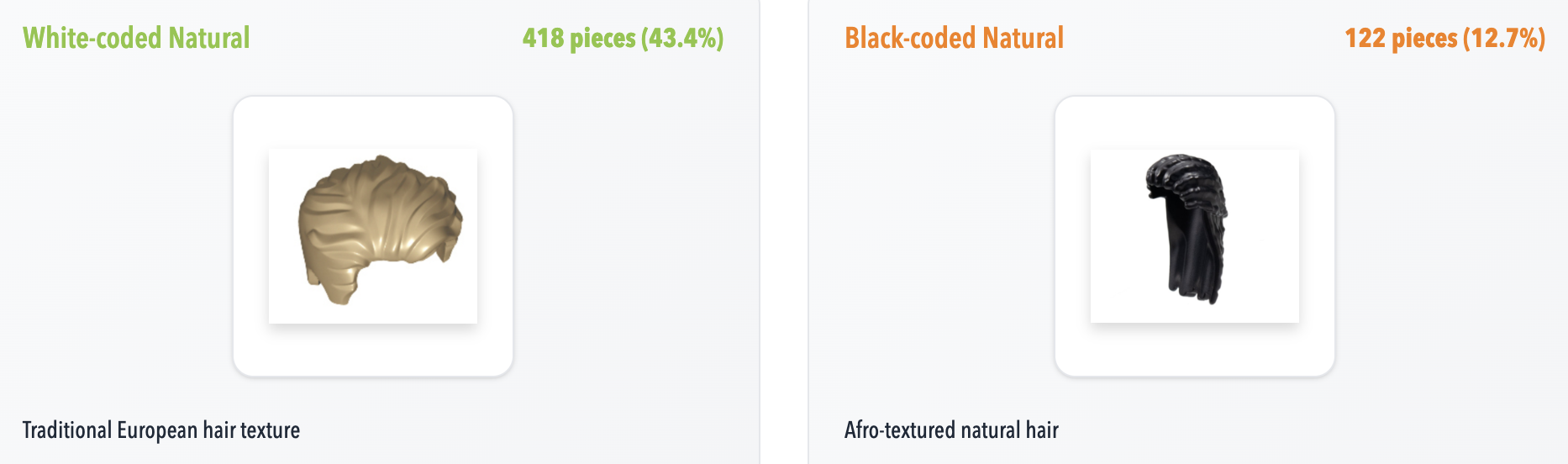

The classification relied on keyword detection from LEGO’s own descriptions and part color names, followed by manual review to ensure accuracy for Black-coded hair.
Importantly, people of all races can have straight, wavy, coiled, or tightly curled hair. These terms are used here not as biological absolutes, but to describe how LEGO styles are culturally coded and represented in their product line.
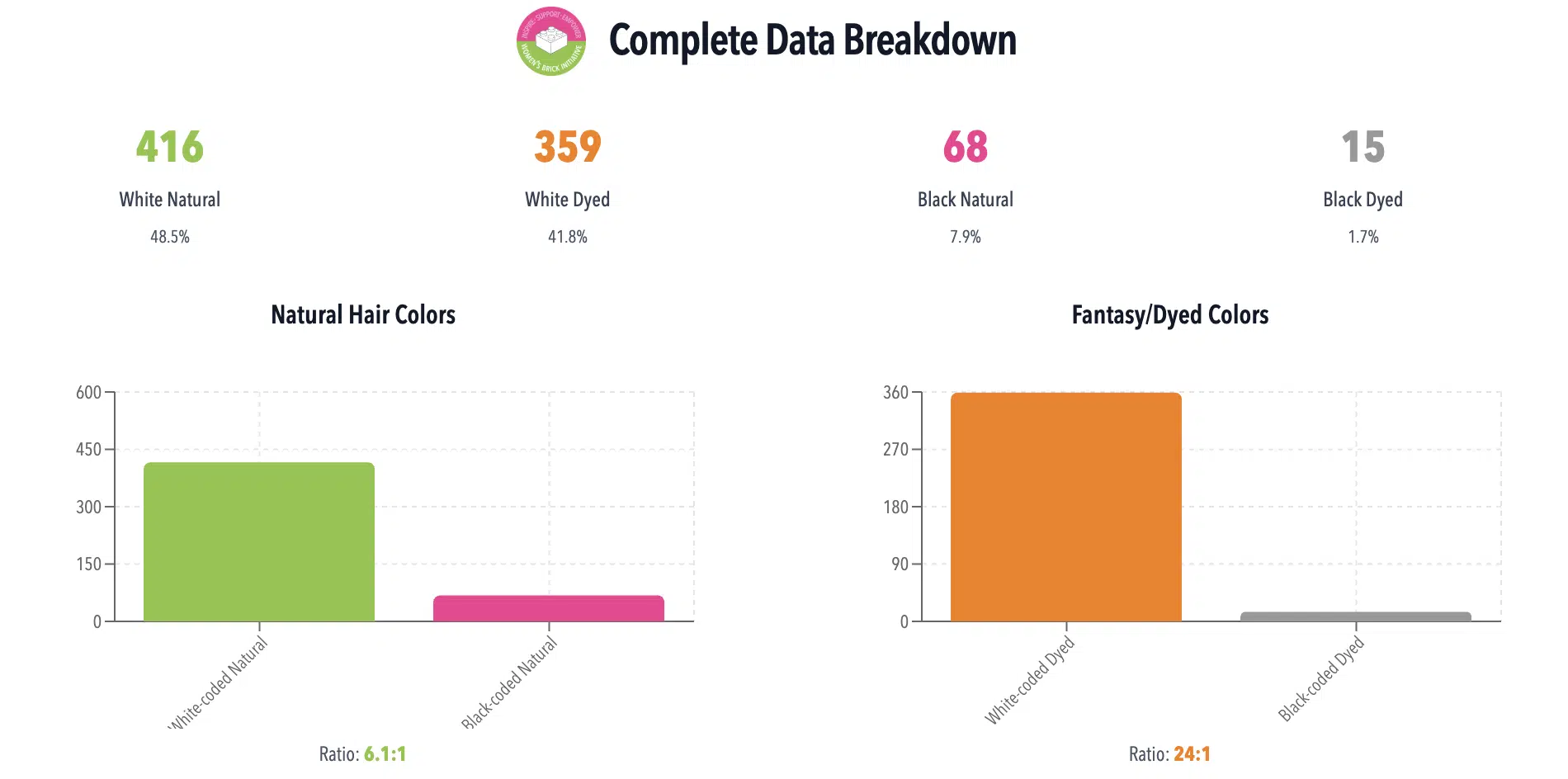
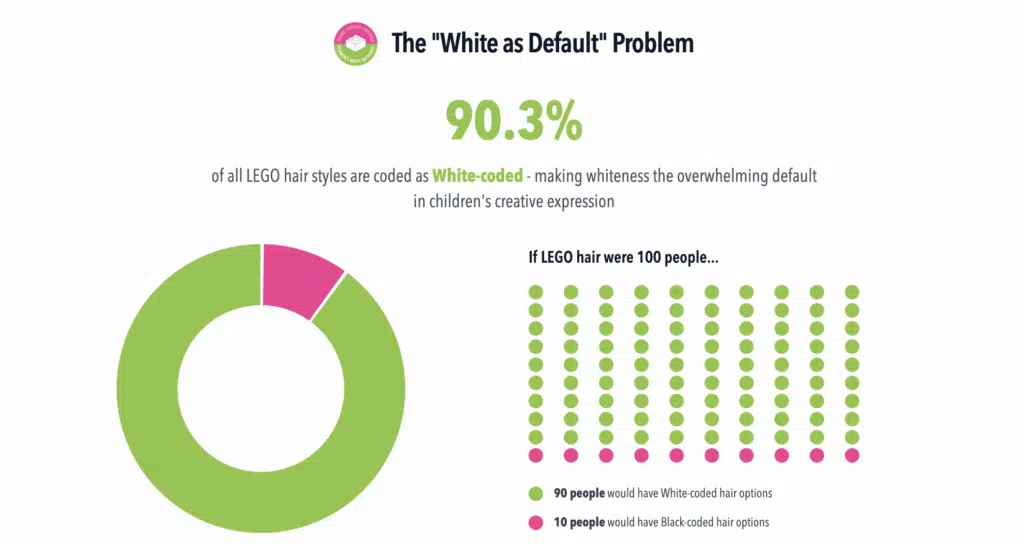
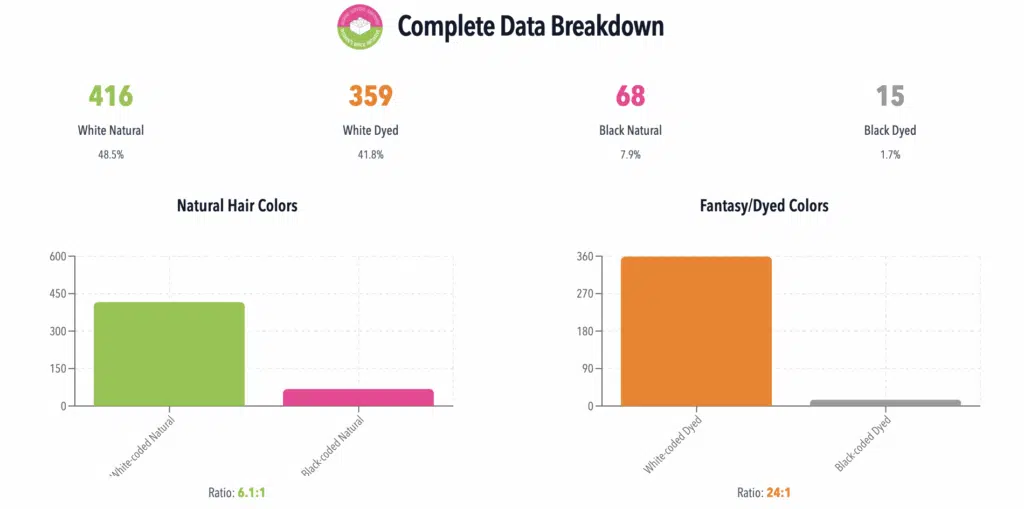
The numbers are stark and undeniable. Of the 859 hair pieces analyzed from LEGO’s extensive catalog, white-coded hairstyles, those featuring straight, wavy, or European-style textures, represent 48.5% of all options. Dyed White-coded styles make up another 41.8%, meaning that 90.3% of all styles in the catalog are White-coded.
By contrast, Black-coded styles, including afro-textured, coiled, braided (excluding braided that were intended for vikings), or dreadlocked hair, account for just 7.9% of pieces. Dyed Black-coded hair makes up only 1.7%. This creates a disparity ratio of approximately 9.3:1 favoring White-coded styles.

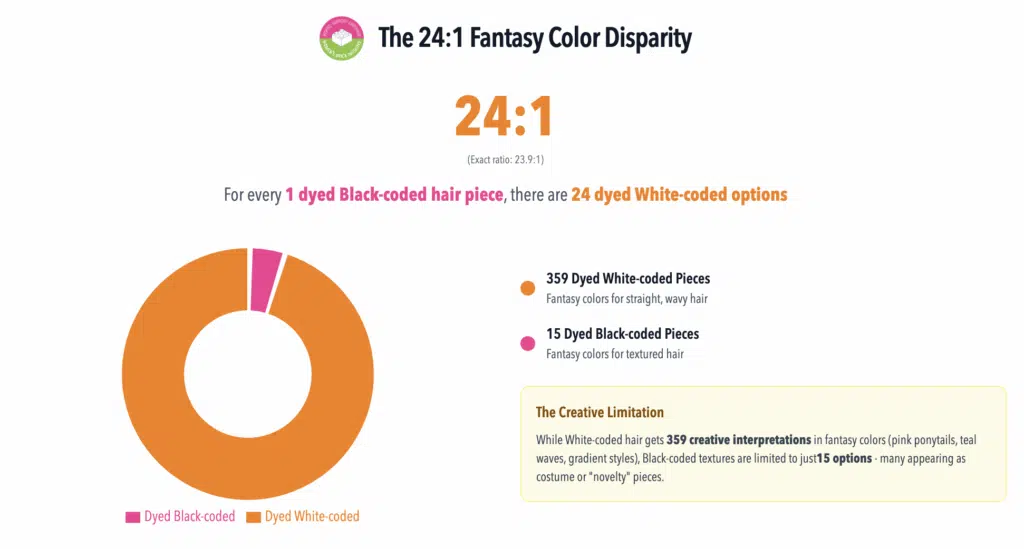
But here’s the punch to the gut. If you’re a Black person with natural hair, or you’re a person of another race who happens to have textured or coarse hair, you’ll discover that dyed Black-coded hair designs are almost nonexistent compared to their White-coded counterparts. For example, dyed White-coded pieces outnumber dyed Black-coded pieces by more than 24:1. While blonde ponytails can be found in dozens of variations and colors, Black afros are mostly limited to dark brown or black, or in rare cases, neon or “novelty” shades that make them look like costume accessories (perhaps even for clowns) rather than natural hair.
When Your Hair Doesn’t Exist in Plastic
As someone who grew up in the early 2000’s, I can already tell you it was difficult finding a Barbie that represented me as a Black person. Even when the child me did find her, she always had flat hair. LEGO minifigures present the same challenge, but with a twist: you’re not just looking for representation, you’re building it piece by piece.
Dr. Ayana Byrd, co-author of Hair Story: Untangling the Roots of Black Hair in America, describes this phenomenon perfectly:
“When children can’t see themselves reflected in their toys, they internalize the message that they are somehow outside the norm, that their natural features are less desirable or less worthy of celebration.”
For children building their world through LEGO, these choices carry profound emotional weight. Hair isn’t just decoration , it’s how we recognize ourselves and signal our identity to the world. When a Black child has to settle for a brown bowl cut because there’s no textured option, or when they can only find their hair texture in neon green (because that’s apparently when LEGO thinks afros are appropriate), the message is clear: your natural self needs to be hidden or turned into a joke.
This disparity isn’t some unfortunate oversight. It reflects what researchers call “white as default”, the unconscious assumption that whiteness represents the standard human experience, while all other identities are variations or special cases. In LEGO’s world, this manifests as White-coded hair receiving endless creative treatment while Black-coded styles remain largely static and limited.

The Weight of Hair Politics
If you’re not Black, you might wonder: isn’t this just about toys? Why does hair matter so much?
The answer lies in centuries of pain that many Black families carry. Dr. Kevin Cokley’s research reveals how negative attitudes toward Black hair reflect “respectability politics”, societal pressures that demand Black people conform to European beauty standards to be deemed acceptable or professional. Your hair can determine whether you get the job, whether you’re sent home from school, whether you’re seen as “neat” or “appropriate.”
This isn’t ancient history. In 2019, a Texas high school told a Black student he couldn’t walk at graduation unless he cut his dreadlocks. In January 2020, DeAndre Arnold, an 18-year-old in Texas, was suspended from school for dreadlocks he started growing in the seventh grade in the same school district. He was threatened with missing his high school prom and graduation and decided to transfer schools. These stories happen every year, in every state, because Black hair continues to be policed in ways that White hair never experiences.
The BBC’s exploration of global hair politics reveals how the criminalization of natural Black hairstyles stems from colonial legacies that persist today. When European colonizers encountered African hair textures, they labeled them “uncivilized” and “unprofessional”, judgments that became so embedded in Western culture that we barely notice them anymore.
So when, let’s say, a seven-year-old girl can’t find her hair texture among LEGO’s hundreds of options, she’s not just facing a toy shortage. She’s encountering the same system that tells her older sister to straighten her hair for job interviews, that sends her cousin home from school for wearing braids, that makes her mother debate whether natural hair is “appropriate” for important occasions.
The Numbers Tell a Personal Story
Let’s get specific about what this looks like in practice. When we dig into LEGO’s hair data, we see multiple layers of inequality that compound the representation problem.
Imagine you’re a parent trying to help your child build their dream LEGO world. If your child has European-textured hair, you’re spoiled for choice. That single ponytail design? It comes in blonde, brunette, silver, teal, magenta, and fantasy gradient options across different themed sets. Your child can be a blonde princess, a silver-haired warrior, a teal-streaked rebel , their hair becomes a canvas for creative expression.
Now imagine your child has afro-textured hair. Of all dyed Black-coded hair pieces in LEGO’s catalog, only a handful represent unique designs. Most cluster around a few basic styles , afros, flat tops, and braided designs , with minimal color variety or creative reinterpretation.
This creates what researchers call “narrative steering”, subtly guiding children toward certain identity expressions while discouraging others. Your child naturally gravitates toward the options with the most variety and creative potential, inadvertently learning that their natural hair texture offers fewer possibilities for self-expression.
Beyond Building Blocks: What This Does to Kids
The real impact happens in moments you might never witness. Like when your child quietly chooses the blonde minifigure for their LEGO movie because “she has more cool outfits.” Or when they build elaborate stories around characters who look nothing like them because those are the figures with the most interesting accessories and hair options.
Dr. Beverly Daniel Tatum, author of Why Are All the Black Kids Sitting Together in the Cafeteria?, explains how these seemingly small choices accumulate:
“Children are constantly receiving messages about who is valued in society. Toys, media, and other cultural products teach them what ‘normal’ looks like and who gets to be the hero of the story.”
The lack of options isn’t an isolated incident, or even something LEGO especially does wrong. They’re the predictable result of a system that treats Black hair as an afterthought, a novelty, or a problem to be managed rather than a natural variation to be celebrated
The Emotional Tax of Toy Shopping and What True Inclusion Looks Like
Parents of Black children know “the talk”, not just about racism, but about representation. About why most dolls don’t look like them. About why their hair texture is called “hard to manage” while straight hair is “easy.” About why they need to search harder, pay more, and settle for less when it comes to seeing themselves reflected in their toys.
The solution isn’t complicated, but it requires a fundamental shift in thinking. LEGO needs to stop treating Black hair as a special category and start treating it as a natural variation deserving the same creative energy as any other hair type.
Imagine if that seven-year-old girl could find curly or coarse hair in every color of the rainbow. Picture braids with fantasy elements, dreadlocks with gradient effects, twist-outs in metallic finishes. Envision Black children being able to build minifigures with purple afros for their space adventures, silver dreadlocks for their medieval kingdoms, rainbow braids for their underwater cities.
This isn’t about political correctness or checking diversity boxes. It’s about recognizing that all children deserve to see their natural features as a starting point for creativity, not a limitation. It’s about understanding that representation isn’t charity, it’s good business and basic human decency.
Some companies are getting this right. When Mattel launched their new line of Black Barbie dolls with authentic textures and varied styling options, they didn’t just add a few brown dolls to the shelf. They created an entire ecosystem of hair care accessories, styling tools, and creative possibilities that celebrated Black hair as beautiful and versatile.
LEGO could do the same. They have the design expertise, the global reach, and the cultural influence to send a different message to children around the world.
A Message Hidden in Plain Sight
LEGO’s current approach sends a subtle but damaging message to millions of children: whiteness is standard, blackness is special-edition. Some identities get to be everything, while others get to be grateful for anything.
For a company whose mission centers on inspiring creativity and imagination in all children, this represents a profound failure to live up to its own values. The Danish company has built its reputation on the idea that every child can build anything they can imagine, but their hair selection suggests that some children’s imaginations are more worthy of support than others.
This isn’t about attacking LEGO or demanding they rebuild their entire product line overnight. It’s about holding a beloved brand accountable to its own promises and pushing them to do better by the children who love them most.
Because somewhere right now, a Black child is sitting on their bedroom floor, sorting through LEGO hair pieces, trying to find themselves. What they find will teach them something about their place in the world, about whose identity matters, about what kinds of dreams are worth supporting with endless creative possibilities.
Every child deserves to find themselves in that pile of plastic pieces. Every child deserves to build their dreams without having to compromise on who they are. Every child deserves hair that looks like theirs to come in every color of the rainbow.
Until that happens, LEGO’s message remains clear: some children get to be everything, while others get to keep searching. For a more detailed breakdown of the methodology, check out these numbers!
Works Cited
BBC. Why Is Black Hair So Political? BBC, 9 July 2020, www.bbc.co.uk/programmes/articles/58psLDd9GGWf5SQKSLmmdjD/why-is-black-hair-so-political.
Byrd, Ayana D., and Lori L. Tharps. Hair Story: Untangling the Roots of Black Hair in America. Revised ed., St. Martin’s Press, 2014.
Cokley, Kevin. “The Politics of Black Hair.” Psychology Today, Sussex Publishers, 18 Dec. 2023, www.psychologytoday.com/gb/blog/black-psychology-matters/202312/the-politics-of-black-hair.
National Museum of African American History and Culture. “Dolls Hold Significance and Break Cultural and Racial Barriers.” NMAAHC, Smithsonian Institution, nmaahc.si.edu/explore/stories/dolls-hold-significance-and-break-cultural-and-racial-barriers.Tatum, Beverly Daniel. Why Are All the Black Kids Sitting Together in the Cafeteria? Rev. ed., Basic Books, 2017.
Are you a black AFOL looking for natural hair black-coded LEGO pieces? Are you a non-black person wanting to learn more about natural black hair? Use our Hair Styler, a fun way (or a call to action for where things are lacking with LEGO) to find the part number for the expressions and hair pieces you want in natural black (female oriented) hair. Note, its a work-in-progress:
1 comment
Håkan
It seems as if the Hair Styler doesn’t load or work correctly.
Maybe my computer is too old and cluttered for it.