

Note: This research as been conducted by and is republished with full permission by one of our members, Ellie M. The original substack article can be found here.
Gender Roles and Ratios in LEGO City (2004-2026)
Background
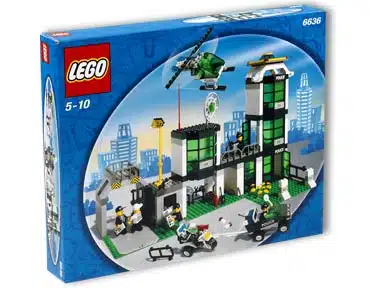
In the early 2000’s The LEGO Group was struggling financially and was in a process of restructuring, revamping, or removing many themes from the catalog. One of the most interesting “revamps” during this time was LEGO Town. LEGO Town was one of the 3 original LEGO themes, along with Castle and Space. 1999 was the last year for LEGO town sets (or “System” branded sets) as in 2000 LEGO branded them City Center. Interestingly, these sets are marked by a diamond logo with the word CITY, even though they are much closer to the classic LEGO Town sets than the city sets we know today. City Center only lasted one year, as in 2001 and 2002 the few sets that were released had blue boxes with absolutely no titles or branding. 1100 Sky Pirates (2001) and 6636 Police Headquarters (2002) are outliers in the sense that they are not classic Town sets, City Center, World City, City, or even Legends sets. (In addition to the sparse new set offerings, LEGO re-released several classic town sets like Breezeway Cafe and Pizza to go as Legends sets) This lack of clear labeling and marketing underscored the identity crisis LEGO was going through at the time.
Starting in 2003 LEGO rebranded their Town/City line to World City, which was the direct precursor to modern day LEGO City. These sets had packaging similar to what you see on LEGO City sets today, blue background with black skyscrapers in the background, blue border etc. with a green street sign World City logo. The minifigures had a very similar appearance to what would become standard LEGO City minifigures in 2005-2010, with more detailed facial features and uniforms. The sets themselves were very distinct from the previous town and city center sets in that they focused on detailed, realistic cars and buildings, with a focus on first responder sets and train sets. Notably lacking from World City were any food, recreational, outdoor, or otherwise “fun” sets and therefore World City can be seen as a more “action-oriented” theme compared to classic town or modern city. Ironically, the one exception to that is a World City Chef polybag, with the chef having no accompanying set, or any other set with any food, let alone a kitchen.
Also of note is the complete lack of inclusion of women in the World City subtheme, save one exception: a mother flying in a passenger plane with her son. The police, Fire, and coast guard jobs were exclusively made up of men, a trend that would carry on in the new LEGO City sets until 2012. From 2003-2011, women in the LEGO World City and City themes either:
- Didn’t exist at all
- Not working a job but rather acting as a mother or single passenger in a vehicle or plane
- Working an odd job, like running an ice cream stand, bank employee, surf shop employee, or something else not connected to the main line of sets they are in
In 2012, there was a concerted effort to bring women into the fold in LEGO City professionally. This year saw the first female firefighters, the first female police officer, and the first female public works employees. Still, in terms of numbers, these trailblazers were the exceptions rather than the rule. 2012 saw 2 female firefighters compared to 11 male firefighters, and a single female police officer alongside 16 males. Women continued to be included at this sparse rate until 2016, a year which saw 7 female firefighters join the force, still offset by 16 males, but a much higher ratio than ever seen previously. 2017 was the breakout year for women in LEGO City police, as they had 10 female officers compared to 14 males. Womens participation in all professions and subthemes increased after this point, but still not matching the level of male representation. The gender shift in LEGO City has shifted from the beginning years having virtually no female representation, to slowly including a few in the early 2010s, to the 2 to 1 male to female ratio we’ve been seeing from 2016 onwards.
Notably, the 2020’s have seen the few and only instances of LEGO City subthemes featuring more women than men, with 2022 Fire sets releasing with 7 total male minifigures and 9 total female minifigures. In 2025 the police sets featured 5 male officers and 6 female officers. There are also many instances of subthemes having an equal number of male and female minifigures from 2022 onwards. Full statistics for all City subthemes are included at the bottom of this article.
In total, there are 1393 male minifigures across all LEGO City sets and just 595 females. This works out to be 29.93% of the total population are women.
Overall, the gender statistics in LEGO City tell a fairly consistent story: Practically no women for the first 5 years of LEGO City, 10-15% representation in the early 2010’s, 30% representation in the mid to late 2010’s, and approaching and sometimes hitting 50% representation from 2022 onwards. What this means is, while men in LEGO City were the dominant (and nearly only) gender in LEGO City at the start, LEGO has been slowly and purposefully moving towards including women at an equal level, although it took 17 years and about a thousand sets to achieve it. What this means practically is any child who has their own LEGO City, or even a fair number of sets that they play with, will most likely have an experience focused more on male minifigures than female minifigs.
To contrast this, LEGO City is not the only fictional city produced by LEGO. There’s also Heartlake City, home of the LEGO Friends sets. This is another long running LEGO IP that is explicitly focused on girls and women. The sets themselves are colorful, vibrant, and wacky, a total 180 from the more casual realistic LEGO City sets. While these sets overwhelmingly feature women, there are no minifigs in these sets, rather LEGO uses a different kind of figure called minidolls. The only real resemblance these minidolls have to minifigs is their hands being able to hold the same accessories and stud holes on their feet. Other than that they look nothing like minifigures and are not nearly as customizable, which just furthers the problem of women and girls not being to easily build themselves in LEGO. To LEGO’s credit, however the Friends lineup of minidolls is extremely diverse and inclusive. While Friends serves as a great theme and great representation for women, it also leans into stereotypes by having minidolls and for the implicit assumption that girls and women will want simpler, less serious, “fun” builds where more realistic sets, as well as practically any action oriented sets, are “reserved” for boys and men.
Perhaps more encouraging than the raw numbers of women in LEGO City are the roles that women take on within the city. Ever since they were allowed to work for the police, fire, coast guard rescue etc. women have taken on highly skilled roles within their departments, either comparable to the men they work alongside or in some cases skilled jobs that men are not depicted doing. For example, while police supervisors are fairly exclusively male, detectives are almost all female. Same can be said with scientists, who lean female. The fire chief, Freya, is a named character in the LEGO City Fire Department and has lead the department from 2019-2023. Women are frequently seen driving vehicles and there are plenty of pilots, with one odd exception. Women are seen piloting fire helicopters, police jets, coast guard helicopters etc. but they are never seen piloting commercial or passenger airplanes. Those pilots have exclusively been male, often alongside female passengers.
One note that should be made is the ratio of crime committed by women in LEGO City. As previously established, they make up 30% of the total population but also almost exactly 30% of the police department. The first female officer started in 2012 while the first female criminal was arrested in 2014. However, since then, women have gone on to make up 40% of the criminal population of LEGO City. Given that from 2005-2013 there were only male criminals, this is a pretty huge jump to make in the last 12 years, and demonstrates that women are 10% more likely to commit a crime than to get a job as an officer. Unlikely that this is a message the LEGO group intends to send.
Finally, we have to examine some of the social roles that exist within LEGO City. This is somewhat difficult to do as LEGO City is so heavily focused on first responder and “action-oriented” sets to the point that there is a severe housing crisis in LEGO City. In 2010, the first family home was built in LEGO City and it was the only one for 11 years. Then in 2021 one more was built. In 2023 LEGO City finally started working to address the issue, building two apartments and another house, bringing our total to 5 family living spaces across a city that’s been being developed for 22 years.
All jokes aside, this creates a scenario where the vast majority of residents of LEGO City either live in what they drive or where they work. The police officers must live in their department or their cars as there is no housing for them. Same scenario for the firefighters, doctors, construction workers, and every other resident in LEGO City. Ironically, there are far more prison and jail cells and beds than there are actual homes or beds, meaning that some criminals may be engaging in their behavior in order to secure housing and food. It should be noted there is no court or justice system, which explains why criminals are constantly breaking out, as even the most trivial crime carries an assumed life sentence.
Examining the 3 houses that exist, all 3 are owned by straight couples with children. One apartment has a girl living with her grandma, and the other is a single bed for a man. That is a grand total of 10 houses people in a city of 2,000, meaning only 0.5% of the population has a non-jail bed to sleep in. As far as queer representation in LEGO City, it is almost non existent. Almost. There is one character in the recent RV Camper set that as LAN YouTuber just2good pointed out, may have transitioned in between vacations. This is obviously not confirmed but super cool if true. There is also the very first LEGO City set to release, which deserves its own explanation.
2004 LEGO City Airport:
As discussed above, LEGO was going through a phase of rapid rebranding of the town/city theme, and this culminated with one last classic town set being rereleased, the 1994 airport set. Unlike the previous Legends branding, however, this airport set featured the blue CITY branding that is still being used today, making it the definitive starting point for LEGO City. There were no other LEGO City sets until the first original ones released in 2005, meaning this set truly stood on its own. What makes this set so unique are the minifigures included. Being a re-release of the 1994 set, the minifigs have their classic, less detailed/polished expressions and overall look nothing like current or past LEGO City minifigures. The set included 10 males and 3 females, notable because there were absolutely 0 women in LEGO City sets from 2005-2006, meaning these 4 were the only ones available. That makes the women included even more interesting. Two of the women are workers, with one working the airport desk and the other as a flight attendant. The other female is traveling, and has a look that’s unlike any minifigs seen in LEGO City since. There are two different versions of this minifigure listed on bricklink due to the various rereleases of this set, par048 and twn037. She is wearing a tracksuit, red pants, lipstick, and as bricklink strangely notes “black male hair” in my extensive research I have not encountered a single LEGO City minifigure with “black male hair” but it is indeed the same short smooth haircut primarily found on waiters and service workers. It is unclear what statement, if any, LEGO was attempting to make with this minifigure, but with no other explanation it can be speculated that she might be the only lesbian minifigure in LEGO City.
I asked LEGO customer service directly about this minifigure on 7/17/2026 and they said that the bricklink listing is only describing all the parts that make up the minifigure, and they don’t believe the designers were making a statement beyond a hairstyle choice, but it nonetheless makes you wonder.
There are no queer relationships depicted in the history of the theme, although there are several straight relationships depicted, most often with the couple also having children. Also, partially due to the lack of lore and written material regarding the sets, it is impossible to know if there’s any nonbinary representation, but it is clear that there are no explicitly and obviously nonbinary people in the theme.
Final thoughts and the path forward:
From the information I have gathered, LEGO City started off as an entirely male oriented and represented theme and has slowly grown into a diverse and balanced city. That is not to undermine how dramatically underrepresented women were before 2017 or how the total population number heavily skews male today. What it does represent is a long, intentional effort to represent women and to do it the right way. While I would argue that LEGO is taking the right steps, there is more work to be done. With LEGO having the core values they do, they should be looking for ways to incorporate nonbinary, genderfluid, intersex, and two spirit people in all LEGO sets. They should also be including intentionally queer couples in sets and they should not be afraid to release a set with a predominantly female minifig lineup. By making these adjustments I am confident that LEGO can make the CITY theme into an even better reflection of its inner values.
Methodology and Data:
I compiled all this data from Bricklink.com, using their subthemes to categorize all sets to determine the ratios of men to women in each subtheme of set, and then added those total numbers to get the total number of minifigures across all sets. I counted all city sets and poly bags and European exclusive foil packs as they had original builds. What I did not include were any super packs or value packs containing multiple city sets that already had their own separate entries. If a set was unique, it was included in this data. I should note that if you were to exclude European foil packs and focus on the numbers in the rest of the world, those foil packs skew male, so women would make up a slightly higher overall percentage of the population in Europe specifically.
Lego City gender breakdown year by year
2004: 9 males 3 females
2005: 28 males 0 females
2006: 42 males 1 female
2007: 34 males 2 females
2008: 54 males 0 females
2009: 37 males 4 females
2010: 61 males 8 females
2011: 55 males 5 females
2012: 58 males 9 females
2013: 79 males 10 females
2014: 66 males 10 females
2015: 78 males 24 females
2016: 79 males 28 females
2017: 72 males 46 females
2018: 80 males 42 females
2019: 83 males 54 females
2020: 80 males 38 females
2021: 70 males 43 females
2022: 82 males 72 females
2023: 85 males 68 females
2024: 70 males 59 females
2025: 66 males 45 females
2026 (as of July): 35 males 25 females
Lego city fire:
2005: 9 men 0 women
2006: 1 man 0 women
2007: 13 men 0 women
2008: 3 men 0 women
2009: 1 man 0 women
2010: 16 men 0 women
2012: 11 men 2 women (1 firefighter 1 fire plane pilot)
2013: 19 men 3 women
2014: 1 man 1 woman
2015: 2 men 1 woman
2016: 16 men 7 women (sharp increase)
2017: 1 men 0 women
2019 14 men, 7 women (2 female supervisors, 2 pilots, 2 regular firefighters and fire chief freya mccloud)
2020: 6 men 1 woman (freya mccloud regular firefighter attire)
2021: 11 men 8 women (2 female supervisors, 1 pilot, freya mccloud firefighter attire)
2022: 7 men, 9 women (3 pilots, fire chief freya)
2023: 3 men, 4 women
2024: 7 men 6 women (1 pilot)
2025: 3 men 1 woman
2026: 2 men 2 women
Grand totals: 144 men, 52 women
Lego city police
2005: 9 men 0 women (2 male crooks)
2006: 2 men 0 women (1 male crook)
2007: 1 man 0 women
2008: 15 men 0 women (4 male crooks)
2009: 1 man 0 women
2010: 2 men 0 women
2011: 19 men 2 women (1 male speeder 9 male crooks 2 female bank employees)
2012: 18 men 1 woman (9 male crooks)
2013: 16 men 1 woman (7 male crooks)
2014: 22 men 1 woman ( 18 male crooks 1 female crook)
2015: 14 males 2 females (8 male crooks 4 female crooks)
2016:12 males 3 females (12 male crooks 3 female crooks
2017: 14 men 10 women (11 male crooks 5 female crooks)
2018: 11 men 7 women (10 male crooks 2 female crooks)
2019: 10 men 6 women (6 male crooks 3 female crooks)
2020: 19 men 8 women (11 male crooks 7 female crooks 1 male bank employee)
2021: 8 men 3 women (3 male crooks 2 female crooks)
2022: 7 men 6 women (6 male crooks 4 female crooks) (1 bank with no employees)
2023: 9 men 6 women (1 female police chief, 1 male police trainer) (2 male crooks 2 female crooks)
2024: 7 men 5 women (1 female forensic investigator) (6 male crooks 4 female crooks
2025: 5 males 6 females (1 male mechanic 1 female mechanic) (3 male crooks 1 female crook)
2026 so far: 3 males 2 females (1 female detective) (3 male crooks 1 female crook)
Totals: 224 males 69 females (132 male crooks 53 female crooks) (1 male police chief, 1 female police chief, 1 female detective, 1 female forensic detective, 1 female mechanic, 1 Male trainer, 1 male mechanic, fairly balanced gender roles for vehicles, 1 male outlier, Chase
Lego city construction
2005: 8 males 0 females
2006: 4 males 0 females
2007: 2 males 0 females
2008: 2 males 0 females
2009: 14 males 0 females 1 supervisor
2010: 0 sets
2011: 0 sets
2012: 14 males 0 females (mining)
2013: 2 males 0 females
2014: 2 males 0 females
2015: 13 males 3 females
2016: 1 male 0 females
2017: 3 males 1 female
2018: 12 males 4 females (scientist, explosives engineer)
2019: 2 males 0 females
2020: 4 males 0 females
2021: 3 males 0 females
2022: 5 males 1 female
2023: 6 males 4 females (architect)
2024: 6 males 3 females
2025: 5 males 2 females
2026: 6 males 3 females
114 males 21 females
More data on the other subthemes is available on request. Thank you so much for reading and feel free to share your thoughts!