
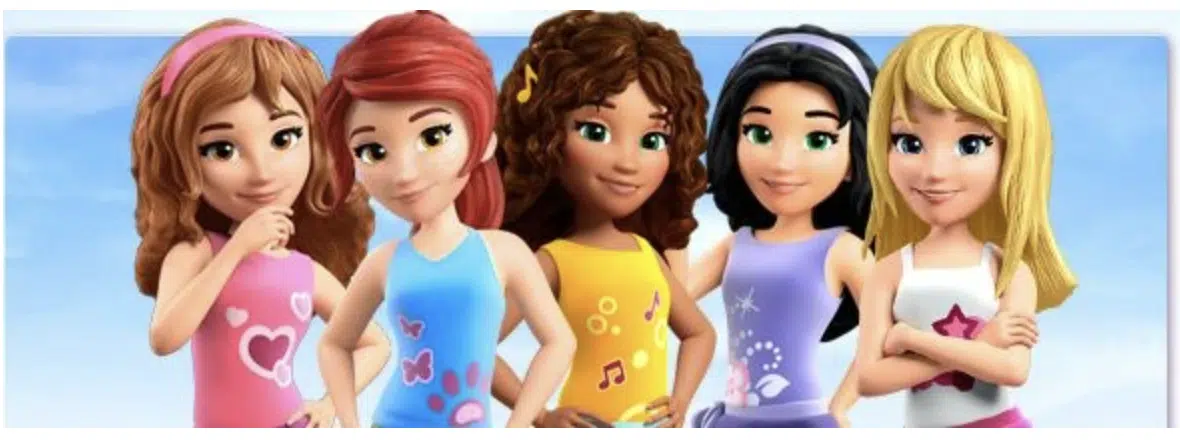
Image from LEGO Friends/brickipedia:
Introduction:
If you’re as chronically online as I am, you may have seen that viral meme comparing Barbie’s face evolution from the 80s to today. It got me thinking: how has LEGO (a company historically dominated by male designers) portrayed femininity in their minifigures over the years? Do these characters offer grounded representations of girlhood that children can see themselves in and aspire to be, or are they plastic cut-outs based on what male designers think will sell to little girls? At the end of the day, LEGO is a toy company, so wanting to sell toys isn’t inherently problematic, but do their products actually align with their stated values that ‘LEGO is for everyone’? Is LEGO’s ‘for everyone’ message genuinely about inclusivity, or is it simply a strategy to sell as many sets as possible, regardless of the impact their minifigure designs might have on their primarily young audience?
Toys shape how children see themselves and form ideas about identity. So I dove into BrickLink data to track how LEGO Friends characters have evolved since 2012. What I found was both encouraging and frustrating.
The LEGO Friends Evolution: From Stereotypes to Substance
Before the full 2023 relaunch, LEGO quietly retooled the original Friends in 2018. No packaging overhaul or storyline reset, just subtle, carefully measured design shifts that hinted at bigger changes to come. These tweaks were easy to miss if you weren’t paying attention. But for anyone tracking representation and character identity, the 2018 reboot was a fascinating moment:
For one, Olivia’s skin tone deepened, subtly altering her racial coding, a move that feels like LEGO testing whether audiences would embrace more overt diversity. Then for Emma, her face shape and features shifted slightly; many fans interpreted the result as more Asian-coded. For Mia, her hair took on a redder tone, adding intensity to her already vivid outdoorsy identity. Andrea gained new hairstyles, a quiet but meaningful nod to Black representation and versatility.And finally, interestingly, Stephanie (the blonde) remained mostly unchanged, almost as if LEGO saw her as the visual baseline not in need of adjustment.
Important Context: The 2023 Reboot LEGO Friends was almost completely relaunched in 2023 with new packaging, more characters and a fresh core cast to replace Andrea, Emma, Mia, Olivia and Stephanie. However, the original five are now depicted as adults, with Mia as a confirmed mother to Autumn in the new storyline.
This makes the 2024 release of Andrea’s Modern Mansion (42639) particularly significant, it sets the stage for a reunion of all the original Friends main characters, featuring adult versions of Mia, Stephanie, Andrea, Olivia and Emma in one set. At 2,275-pieces and with a 14+ age rating (the highest ever for LEGO Friends), this set signals a maturing of the LEGO Friends theme.
From glittery skirts to STEM gear to adult reunions, here’s how Andrea, Emma, Olivia, Mia, and Stephanie transformed across more than a decade of storytelling.
Andrea: The Glow-Up Queen
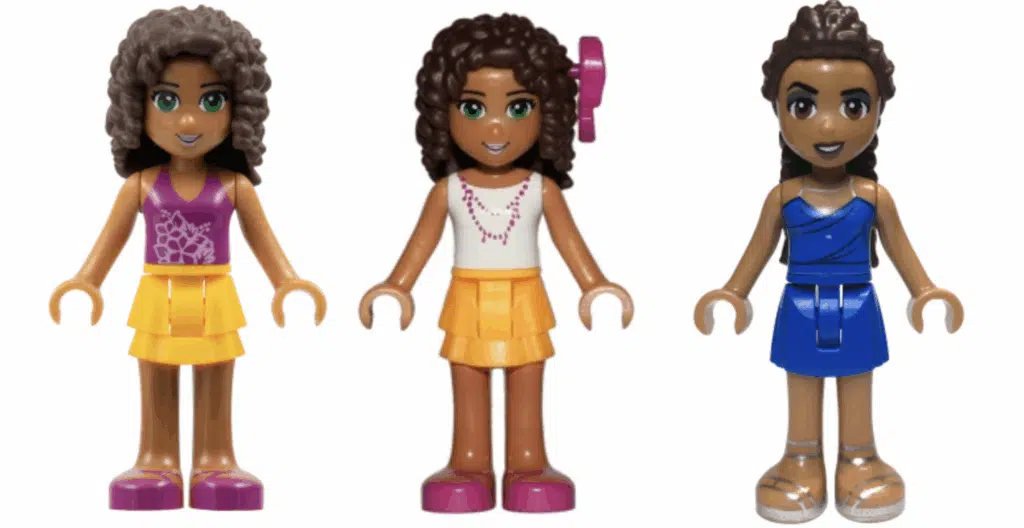
2014 (frnd055): Bright orange layered skirt, magenta top, flower accessory, peak “teen pop star” vibes. Absolutely something I would love to rock as a pre-teen. Her head print featured relatively small eyes and subtle makeup details, classic early Friends aesthetic.
2015 (frnd132): White top with music note necklace print. It’s a little on-the-nose but consistent character branding. The facial features remained fairly restrained by today’s standards.
2018 saw the start of subtle changes, most notably, Andrea began to appear with more varied hairstyles, an early sign of LEGO recognizing that Black girls deserve more than one kind of hair.
2024 (frnd676): Blue halter dress with silver straps. Andrea’s mature, elegant, clearly aged up with sophisticated metallics! But here’s where the reboot becomes fascinating: her head print now features dramatically larger, more expressive eyes that seem to sparkle with personality rather than just decoration.
2024 (42639): As an adult in Andrea’s Modern Mansion, Andrea hosts a reunion of all her childhood friends, showcasing her evolution into a successful adult who values her platonic relationships, who doesn’t love that?
The Reboot: Andrea’s skin tone appears slightly more ambiguous in recent releases, suggesting LEGO may have been testing whether audiences would accept (or rather, spend money) more diverse representation. The larger, more animated eyes in her 2023+ versions create a character who feels more emotionally present, she’s not just performing femininity, she’s expressing it authentically.
Andrea’s journey from teen pop princess to confident adult woman showcases actual character development. LEGO lets a female character mature without losing her core identity. This might not look like a lot, but it’s a bit revolutionary for a company that once equated “girl LEGO” with “make everything pink.” for a solid chuck of its history. I say this as a woman who likes the color pink (and other colors!).
Emma: From Art Fan to Creative Professional
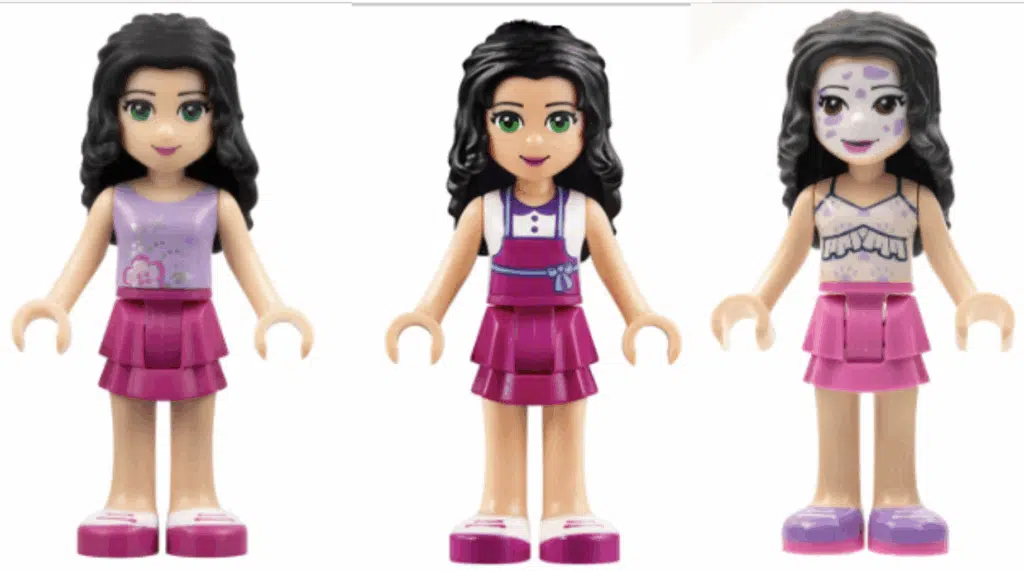
2012 (frnd001): Magenta skirt, lavender top, green shoes, quirky “artsy tween” with paintbrushes and bows. Easily someone I’d want to emulate as a kid. Her original head print was notably pale with delicate features.
2017 (frnd183): Dark pink skirt with apron print, transitioning from art admirer to active creator. Still maintaining the original subtle eye design.
In 2018, Emma’s facial features shifted slightly, her eyes widened, her skin tone warmed, and fans began noting she looked more distinctly Asian-coded. It’s one of the first clear examples of LEGO quietly widening the lens on who gets to be the “creative girl.”
2021 (frnd442): Teal utility jacket, dark blue trousers, flats. Stylish yet grounded, like someone writing the next indie film.
The Reboot Revelation: Emma’s 2023+ versions show the most dramatic shift in representation. Her skin tone is noticeably warmer and more olive-toned, while her eyes have grown significantly larger and more expressive. This isn’t just aesthetic evolution, it’s LEGO quietly expanding who gets to be the “creative type” in their universe.
Emma dropped the accessories and picked up ambition (in my humble opinion). Her palette stayed chic while her style matured authentically. LEGO is showing here that girls can be both stylish and serious about their careers. But more importantly, they’re showing that creativity doesn’t have one specific look or ethnicity.
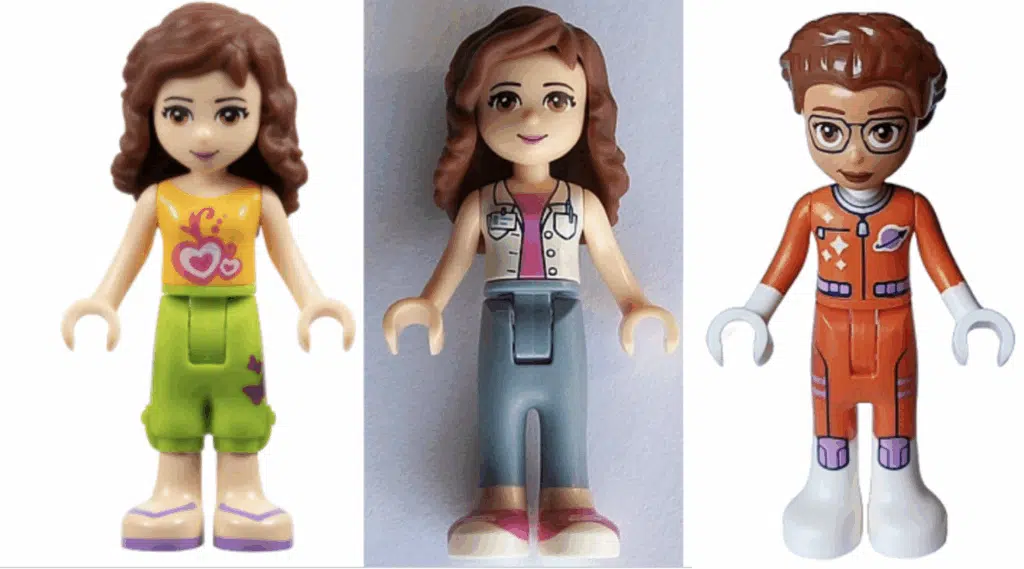
Olivia: The STEM Struggle
2012 (frnd006): Purple capris, light pink top, robot accessory. It’s giving “we want STEM but we’re scared it won’t sell to girls” energy, because girls can be anything as long as they’re pretty while doing it. Original head print: conventionally pretty with small, neat features.
2017 (frnd228): Toolbelt-printed shirt, lab goggles. Finally looking like an actual scientist, not apologizing for being smart. It’s more grounded and reflective of the girls who were passionate about STEM that I knew growing up.
Olivia’s skin tone became richer in 2018, marking the beginning of her transition from a “palatable STEM girl” to one who looked like the actual Black and brown girls pursuing science in real life.
2024 (frnd692): Dark teal cargo pants, tech vest. Sleek, practical, unapologetically techy. I love it!
The Reboot’s Boldest Move: Olivia’s transformation includes both darker skin tones and the signature enlarged eyes of the reboot era. But here’s what’s crucial: her larger eyes don’t make her look more “girly” in a diminishing way, they make her look more determined, more focused. LEGO learned that you can make a character more expressive without making them less serious about science.
Olivia’s evolution from “smart but sparkly” to confidently scientific represents LEGO’s biggest learning curve. It’s frustrating it took over a decade, but better late than never. The fact that her reboot version is visibly more diverse while also being more authentically scientific shows LEGO finally understood that representation and substance aren’t mutually exclusive.
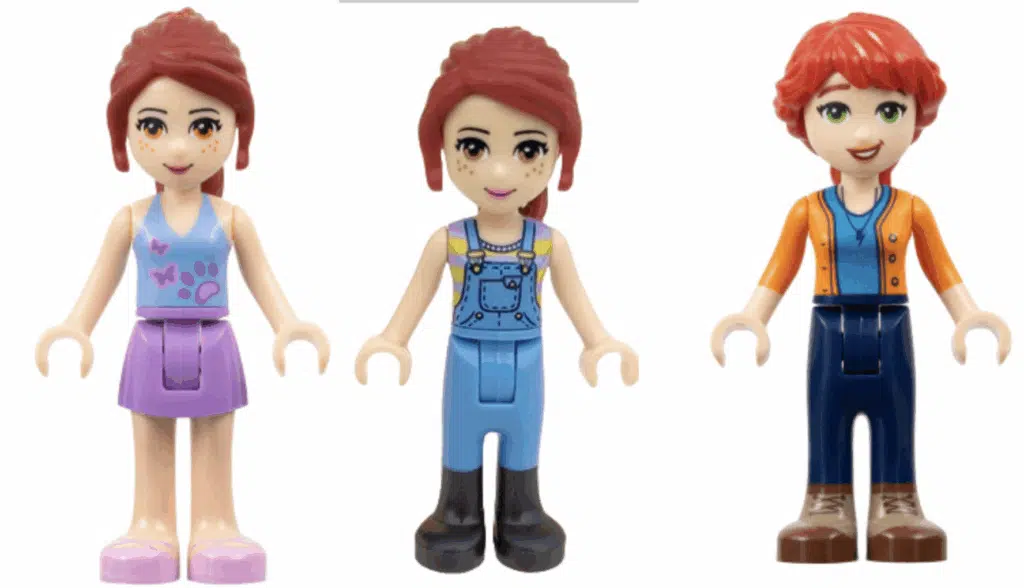
Mia: The Consistency Champion
2012 (frnd009): Tan trousers, forest green vest, horse. No skirt, no makeup, LEGO’s clearest “outdoorsy” character from day one. I like her (even though “outdoorsy” people can wear glitter and makeup and “indoorsy” people don’t have to). The original design featured medium skin tone and practical hairstyles.
2017 (frnd224): Cargo shorts, boots, animal rescue missions. The grounded color scheme stays consistent.
Mia’s changes were more visual than conceptual. Around 2018, her hair shifted to a noticeably redder hue, injecting her consistent design with a bit more intensity and individuality.
2023 (frnd585): Beanie, puffer jacket, gloves. Winter-ready and practical as ever.
The Reboot’s Subtle Touch: Mia shows the most restrained changes in the reboot, but they’re telling. Her skin tone has become slightly more defined and consistent, and her eye design, while larger, maintains her no-nonsense expression. LEGO seems to recognize that Mia was already working, she just needed the same visual refresh as everyone else.
LEGO barely touched Mia’s core design, and that’s the highest compliment I can give them! She’s been authentic and consistent across ten years (it’s also proof they could have gotten it right from the beginning). The reboot changes feel like technical updates rather than personality overhauls.

Stephanie: From Team Mascot to Leader
2012 (frnd008): White skirt, lavender polo, blonde ponytail. “Girl-next-door team captain” energy. Very fun, very preppy. Classic small-eyed, conventionally pretty design.
2016 (frnd191): Athletic gear with medal and running shoes. Shifting from “cute athlete” to “serious competitor” and still glittery!
What’s most telling is that Stephanie’s design remained largely untouched during the 2018 refresh. In a lineup where everyone else was shifting slightly ,skin tone, hair color, face shape, Stephanie’s stasis feels pointed. LEGO may have considered her the “default” girl, the one who didn’t need updating.
2023 (frnd632): Tracksuit and ponytail, but now she looks like a coach, not a cheerleader. More determined, less decorative.
The Reboot’s Leadership Lesson:
Stephanie’s reboot design maintains her blonde hair and light skin tone, but her enlarged eyes now convey authority rather than just friendliness. The bigger eyes that might have once made a character seem more vulnerable now make Stephanie look more commanding, a brilliant subversion of the “big eyes = helpless, cutesy, baby” trope.
Stephanie matured from team mascot to team leader, representing LEGO’s growing understanding that girls can be both feminine and authoritative.
The Reboot’s Bigger Picture
The 2023 reboot didn’t just update wardrobes, it fundamentally changed how LEGO Friends characters look and, by extension, how children playing with them might see themselves. The enlarged eyes serve multiple functions: they make characters more expressive and emotionally present, but they also seem designed to work across different ethnicities, allowing for more diverse representation without losing the “LEGO Friends aesthetic.”
Shifting Diversity: In our research, we noted the characters becoming “overtly more ‘not white'”, which suggests LEGO was indeed testing the waters with subtle changes before committing to more obvious diversity in the reboot. Emma’s olive skin tone, Olivia’s darker complexion, and the general warming of skin tones across the line indicate LEGO finally understood that “for everyone” had to actually mean everyone.
The Eye Evolution: The larger, more exaggerated eyes in reboot versions don’t just make characters look more animated, they make them look more alive, more capable of complex emotions and thoughts. When Olivia’s eyes are bigger, her scientific focus seems more intense. When Andrea’s eyes sparkle more, her creativity feels more authentic rather than performative.
And while 2023 made these changes explicit, the groundwork was laid quietly in 2018. That mini reboot now reads like LEGO dipping a toe into the waters of representation, before fully committing five years later.
What This All Means
When you chart LEGO Friends through BrickLink data, a nuanced story emerges that can be both encouraging and frustrating. Each character follows a different arc, but together they show LEGO evolving from “girls like pink and pretty things” to “girls are complex humans with diverse interests,” and now to “those girls grew up to be accomplished adults who represent diverse communities.”
The 2024 Andrea’s Modern Mansion set represents the ultimate validation of this character development, bringing back adult versions of all five original characters in what’s described as a “friendship reunion.” At 2,275-pieces, this set signals a maturing of the theme that aspires to reach beyond traditional confines.
The progression is meaningful but took over a decade, suggesting these toys for girls didn’t involve enough women,or people of color,behind the scenes initially. The reboot’s more obvious embrace of diversity suggests LEGO spent years quietly testing whether their audience was ready for change, rather than leading with bold representation from the start.
Where LEGO Still Falls Short
Let’s be honest: LEGO Friends still exist separately from regular LEGO sets, and that’s problematic. Why do we need special “girl” minifigs with different proportions? The larger eyes and curved torsos still send the message that girls need special, more “feminine” versions of LEGO people. Why can’t girls exist in the main LEGO universe without being segregated into their own corner? Is LEGO trying to make an affinity space for girls/women or is it more of the myth of “separate but equal”.
The fact that it took until 2018 for Olivia to look like she belonged in a lab is embarrassing, especially considering LEGO’s extensive catalog of male scientist figures. And the gradual approach to diversity, while ultimately positive, suggests LEGO was more concerned with market testing than genuine representation.
What LEGO Got Right
Credit where it’s due: LEGO did course-correct. The 2020s versions of these characters feel like real people with authentic interests, and the reboot versions finally look like they represent the actual diversity of girls playing with these sets.
The eye evolution, while potentially controversial, actually works in LEGO’s favor. The larger, more expressive eyes make characters feel more emotionally intelligent and present, which is exactly what you want in toys that help children explore identity and relationships.
Most importantly, they learned that girls can love pink AND be complex, ambitious, and multifaceted. The reboot shows they also learned that girls can be diverse AND complex, which feels like a crucial second lesson.
Now consider:
What story is each LEGO girl telling now? Because whether we like it or not, these tiny plastic figures are shaping how the next generation thinks about what it means to be a girl, and crucially, which girls get to see themselves represented in mainstream toys.
LEGO has come a long way, but they still have work to do. The reboot’s changes suggest they’re finally ready to do it more boldly. And we’ll be watching.
What do you think about LEGO Friends’ evolution and the reboot changes? Share your thoughts in the comments below!